
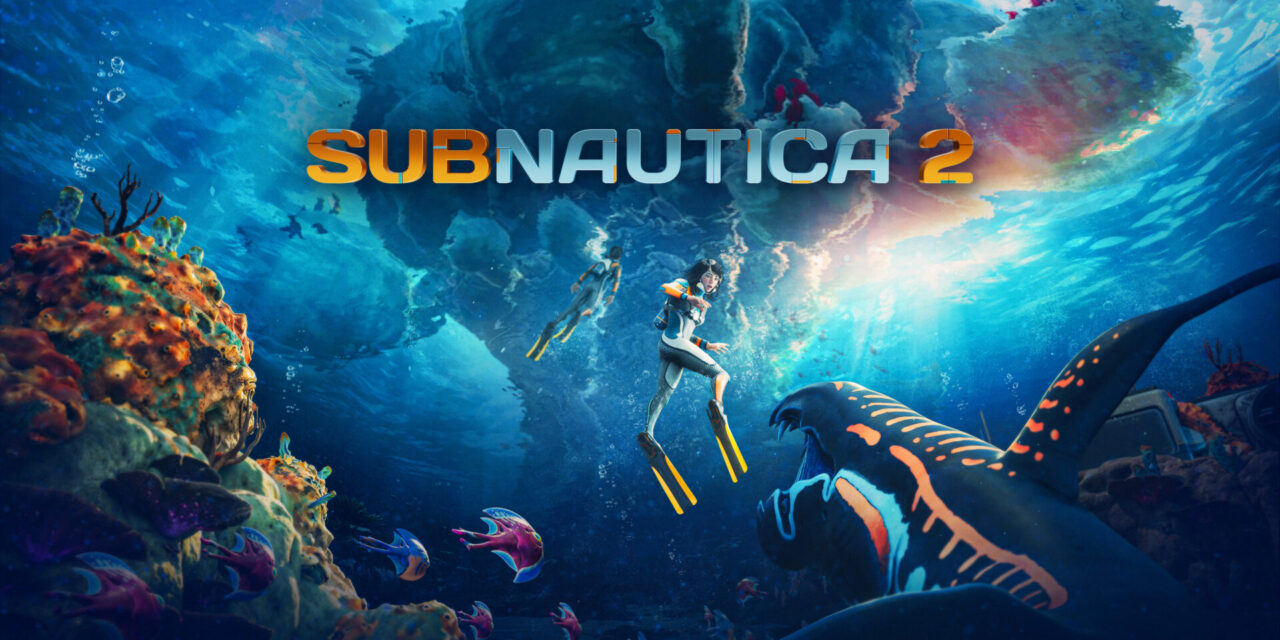
Unknown Worlds Entertainment, developer of Subnautica 2, invited players to dive back beneath the surface today as the much-anticipated sequel launched into Early Access on PC and Xbox consoles, returning the alien-ocean survival and crafting series to players’ hands.
From early childhood, I wanted to be a marine biologist. The first Subnautica spoke to that old fascination, and watching Subnautica 2 revisit its language of exploration — creatures slipping out of the grey-blue, golden fish twirling through shimmering light — brought it all back with surprising force.
“You’ll hear it colloquially, commonly called a survival game, and it is a survival game, but we think of it more internally as an exploration game,” Design Lead Anthony Gallegos told a group of gathered reporters during a briefing. “It’s an exploration game primarily, first and foremost, about going through an alien world, and the survival elements all serve to drive the exploration.”
Hunger, oxygen and danger still exist to push the player deeper into alien ecology, but they are not the foremost and brightest narrative of the gameplay.

“The first Subnautica launched into early access with an empty ocean and a great deal of borrowed trust; the franchise has spent the better part of a decade making good on it, and that track record is the most honest thing Unknown Worlds can offer a skeptical player today.” – Garamond Sans
As in the first game, players will find themselves stranded on a new planet. It is not just an extension of the first Subnautica, but a whole new world: bigger, weirder and more expansive. Although players will begin in shallows quite similar to 4546B, the original world, Subnautica 2 will diverge quickly from there, allowing them to acclimate before learning how to explore and survive.
“Fans wanted something that was more of the alien worlds to explore, but they wanted it to feel fresh. And so for us, the freshness of that really comes from the fact that we have a new planet,” Gallegos said.
Just like the original game, players start with familiar equipment. The core of that experience is the scanner, not only because it unlocks blueprints, but because it makes the player become a field researcher. It is central to the exploration aspect of Subnautica, turning the act of survival into collection and study. How many hours did many players spend in the first game chasing down various darting animals and waving plants just to read their entries and learn the strange ecology of the planet they were on?

“There’s something quietly radical about a game that makes you want to stop everything and read about the taxonomy of a fish — not because you need to, but because the world has made you care enough to ask.” – Helvetica Sans
Much of the game’s narrative was hidden deep in the lore written into its flora and fauna.
According to Gallegos, Subnautica 2 will be no different.
“We know that a lot of fans treat this game, often, like they’re almost doing the equivalent of a David Attenborough Earth-type thing, and just going about learning the creatures,” Gallegos quipped.
One of the concepts that stood out during the briefing was the bloom or blight. Something we learn early in marine biology is that blooms happen when ecological processes go wild in imbalance. Most people may recognize this through oceanic wrongness such as red tide, when seas overload with toxic algae, sometimes turning reddish-brown, killing fish and contaminating seafood. In Subnautica 2, the bloom is an infection that invades the local ecology, causing creatures to become more aggressive and changing the color palette of infected areas.
The core of this principle is that the alien environment and its animals are not “bad.” They are suffering. The creatures of this world are not loot piñatas or moral enemies to plow through; there is a deeper puzzle afflicting them that needs solving.

“Calling the bloom an infection rather than an infestation is a small choice with real consequences: it makes aggression a symptom, not a character trait, and quietly forecloses extermination as the path of least resistance.” – Bodoni Sans
In keeping with the alien-world premise, the designers also incorporated a system of self-evolution that allows players to build their own progression through genetic adaptation. Early on, the player will not be able to eat the planet’s fish or plants, but over time they can unlock adaptations that help them survive. Gallegos described the system as a kind of light genetic manipulation, but not quite like BioShock plasmids. There is also a secondary biomod system that allows players to equip and unequip temporary creature-derived abilities.
Base-building and vehicles have also changed since Subnautica. Bases were modular and built from distinct pieces in the original game; in the sequel, they will be shaped with what the designers called a sculptural system, allowing for a much more flowing design. This includes windows and walls within sea bases, letting players design floor plans that are more aesthetic than merely functional, with an eye for light, space, and detail.
There will also be a wider variety of undersea vehicles, including one like the giant Cyclops teased during the briefing. Many of them will work from a central chassis that can be modified with different attachments. In the case of the larger submersible, which many players may turn into a mobile base, the sculptural floor-plan tools will be able to modify the internal space, but its chassis will remain unaffected.
The game will also feature an optional co-op mode for up to four players. It will support cross-play between platforms, and players will be able to save their game state at any time, allowing them to start up their own solo or multiplayer instance from whichever point they choose.
According to Gallegos, the experience does not tether players together. Groups can divide labor and wander apart, preserving some of the deep sense of thalassophobia and isolation that accompanies the series even when friends are somewhere else in the water.

“The infrastructure of Subnautica 2‘s co-op — no forced tethering, portable saves, seamless solo-to-multiplayer conversion — feels less like a feature list than a considered position on what optional multiplayer should mean in a game built around solitude.” – Palatino Sans
Subnautica 2’s Early Access launch has also been a long time coming for fans, after the game’s expected 2025 window slipped amid Unknown Worlds’ legal fight with owner Krafton Inc. We covered that dispute in more detail previously, but for this preview the simpler point is this: after months of uncertainty, the sequel is finally ready to let players back into the water.
The game enters Early Access today with a launch price of $29.99. Early Access is planned to last about two years. The original game spent four years in early access, and Subnautica: Below Zero spent about three years in that mode.
Image: Unknown Worlds Entertainment



Recent Comments